

Your input will help us improve your experience.
Your input will help us improve your experience.You can close this popup to continue using the website or choose an option below to register in or log in.
Already have an account? Sign in
Sign up free to keep exploring.
We use Necessary cookies to make our website work. We’d also like to set optional Functional cookies to gather anonymous site visitation data and Advertising cookies to help us understand which content our visitors value the most. By enabling these cookies, you can help us provide a better website for you. These will be set only if you accept.More information about the cookies we use can be found here Cookies Policy
Thanks for visiting TopUniversities.com today! So that we can show you the most relevant information, please select the option that most closely relates to you.
Views
How to be a Great Global Employee
Save
Share
Share via
Share this Page12
Table of contents
Table of contents
Both educators and recruiters are telling business students to get on the globalization train if they want to work in businesses of the future. To succeed in business today, you need to be able to work across borders. That requires a new set of talents and skills. In other words, business education now is not the way your parents learned it.
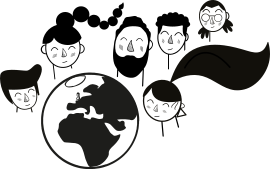
The most important business skill needed today is the capability to have an expanded worldview, says Roland Siegers, executive director of CEMS, a global alliance of academic and corporate institutions founded to educate the next generation of business leaders. In essence, an expanded worldview means having lived through experiences that allow you to see the world from different vantage points. It refers to the recognition that people in different places live by unique sets of cultural norms. Business people with these experiences recognize the worth of different cultures and understand that they need to work together with them to succeed in business.
Siegers distinguishes an expanded world view from the “global mindset,” which he says is simply a positive attitude about what different places and people might offer. The former has people probing deeper, learning more about various cultures, and immersing themselves in such a way that they become true global citizens.
Those who want to remain employable well into the future must discover their expanded worldview. Discover Siegers’ suggestions on how to do that below:
Get out of your comfort zone
Take the more challenging road once in a while, suggests Siegers. Instead of accepting the job everyone else in your cohort got offered, consider an industry you haven’t been exposed to just yet – but that will allow you to grow your skills and knowledge much quicker. Consider the small startup attempting something vanguard. Or take on a project in a more obscure place. Work with those whose culture and experience is different from yours. The point, he adds, is to challenge yourself to both broaden your horizons and build on your network.
Live and work somewhere else
Certainly, traveling abroad has value in this new system. Living and working for an extensive period of time in a place and really having a chance to observe the culture is a great way to gain experience. Learning another language is of course helpful, too. It always helps you to better understand the point of view of another culture.
Maximize creativity
One of the bonuses from experiencing different people and places is the ability one gains to tune into creativity. To further expand your creative thought, Siegers suggests brainstorming with diverse groups of people from across borders. Find people to inspire you, wherever you go, he adds. Open your mind to the many possibilities and creative thought will flow. Then, be willing to draw on the best ideas from different places to come up with one strong plan or strategy.
Become less judgmental
Humans can’t help but judge. We have preconceived notions about life, the world and business, too. But in this new global economy, judging others without fully understanding the situation and culture won’t get you far. You have to recognize that you may be projecting your values and ideas onto other people. Next, you have to overcome those impulses by recognizing that other ideas and viewpoints are shaped by cultures and experiences which are undoubtedly different from yours. Different is not bad. It’s just different, says Siegers. Also, you must realize that other people are labeling you, too, he warns. It helps to understand how you may be perceived before you can put yourself in other people’s shoes. Once you pull away at all these strings, you can begin to build a relationship.
Learn to adapt
The first step in adapting is becoming less judgmental and recognizing that cultural norms differ from place to place. Then try to take on those uncomfortable challenges previously discussed. Most importantly, you have to be flexible. You have to try to understand the new environment and the people in it. Why are they doing things in this way? Why do they say this and that? Communication is the key to adapting. You must talk to people. Communicating is about the vantage point from which you are speaking, says Siegers. It’s about where you’re coming from and who you are in the context of those with whom you are communicating, he adds.
Build relationships
After you begin to understand the origin of another person’s perspective, you can begin to find ways to relate to him or her. That is when you can build a relationship. It’s not just about being a LinkedIn contact or Facebook friend, warns Siegers. You have to befriend the other person, too. Relationships – even professional ones – must be deeper than a social media profile. Indeed, business and society nowadays is broken down into networks. You have to build a vast network that travels across borders, cultures, and languages to be successful. An ability to create such a network begins with one’s willingness to reach out to others. Some people may have to push themselves, says Siegers. You have to be unafraid to make new contacts and reach out, all the while considering cultural norms and being careful to appropriately communicate. Most importantly, you must be available and willing to talk.
Welcome the future
Change can be hard for some people. But nowadays change is everything. This is actually great news, reminds Siegers. In the world of work, this evolution means more people are coming into the mix. Parts of the world that are currently neglected, or ignored, will become players in both education and business, and this will give us a richer variety of opportunities in the workplace. Business programs will include e-learning, half-time, full-time, and blended programs, just to mention a few of the new developments in that area.. Of course, programs will grow more specialized and customized to the individual student. This is the wave of the future. But some things will never change, and that’s fine, too, says Siegers.
One thing is true and will remain true, he adds. Education sets you apart and gives you a way to the future.
Francesca Di Meglio has written about higher education for two decades. She covered business schools and all aspects of management education for what became Bloomberg Businessweek from May 2004 to December 2013. Di Meglio was the consultant editor for the book Admitted: An Interactive Workbook for Getting into a Top MBA Program (85 Broads Publishing, 2011), which was written by admissions consultant Betsy Massar. In addition, she is a family travel and parenting blogger at the Italian Mamma website.
Recommended Articles Last year
Universities of the future:…
Nunzio Quacquarelli interviews leaders of universities who are innovating in the world of higher education. In this article, he speaks to Professor John Quelch from Duke Kunshan University.
Thought leadership and the M…
TopMBA sat down with Tsinghua University's Associate Dean, Professor Xin Xu, to talk about expanding horizons, transforming business education for a new economy and striving to become the world’s best business school.
Changing the Gender Paradigm…
Business schools have an opportunity and responsibility to model future leadership that shifts the gender paradigm, says RSM’s Dianne Bevelander.